Online table games use live video or random number generators, with different rules and structures across card games, roulette and poker.
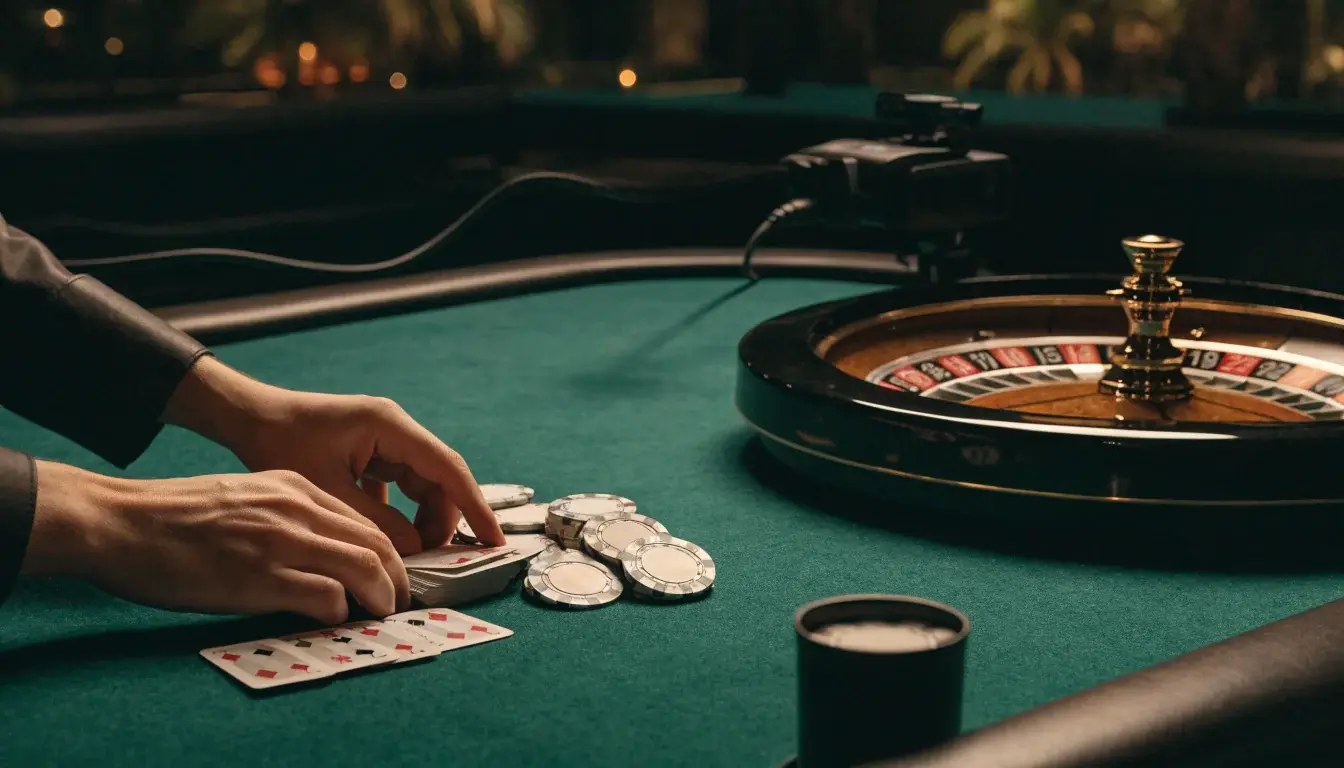
How Online Table Games Work
Online table games are delivered through one of two basic mechanisms: a live video stream showing a real dealer and casino equipment, or software that uses a random number generator (RNG) to determine the result. The distinction is about how the game is produced and presented. It does not depend on whether the screen resembles a physical table.
Live-dealer games: a streamed table
In a live-dealer game, a real dealer operates real casino equipment, and a video feed of that activity is streamed to players. The screen therefore shows an event taking place at a physical table rather than an outcome generated solely as an on-screen animation.
The stream is the connection between the table and the viewer. It lets you watch the dealer and equipment as the game proceeds. What appears on screen is video of the live activity; it is not the same thing as a digital simulation that draws cards or determines a roulette result through an RNG.
This format can look like a conventional casino table because it includes a dealer and physical equipment. But the delivery is still online: the player receives the activity through streamed video rather than being present at the table. The fact that a dealer is visible does not, by itself, explain every part of how a particular service operates. It identifies the central feature of the format: a live dealer and real equipment are shown to remote viewers.
Choosing a real-money casino for table games in Australia means checking the available operator information before you decide where to play. Use these brief verdicts as a reference, and review the terms that apply to you.
-
JeetCity Casino
- License
- Curacao eGaming (Dama N.V.)
JeetCity Casino is listed with a Curacao eGaming license held by Dama N.V. This gives you a stated licensing detail to consider.
-
Bizzo Casino
- License
- Curacao Gaming Control Board (TechSolutions Group N.V.)
Bizzo Casino is listed with a Curacao Gaming Control Board license held by TechSolutions Group N.V. You can use that licensing information as one point of reference.
-
WinSpirit Casino
- License
- Curacao eGaming OGL/2024/923/0383 (Antillephone N.V.)
- Min. deposit
- A$30
WinSpirit Casino lists a Curacao eGaming license, OGL/2024/923/0383, held by Antillephone N.V., and a minimum deposit of A$30. These are the stated details to weigh when considering it.
-
DragonSlots Casino
- License
- Curacao Gaming Authority (Jumpman Gaming Ltd)
DragonSlots Casino is listed with a Curacao Gaming Authority license held by Jumpman Gaming Ltd. That is the operator's stated licensing detail.
-
Playfina Casino
- License
- Curacao eGaming (Hollycorn N.V., since 2017)
- Min. deposit
- A$20-30 (depends on the offer)
Playfina Casino lists a Curacao eGaming license held by Hollycorn N.V. since 2017, with a minimum deposit of A$20–30 depending on the offer. Check the offer terms to see which deposit amount applies.
-
Kingmaker
- Payout speed
- crypto ~90 minutes, fiat 1-5 days
- Min. deposit
- A$30
Kingmaker lists crypto payouts at around 90 minutes and fiat payouts at 1–5 days, alongside a minimum deposit of A$30. These details can help you assess its payment arrangements.
-
Golden Pokies
- License
- Curacao
Golden Pokies is listed with a Curacao license. No further operator details were provided, so this verdict is limited to that stated fact.
-
Vegaz Casino
- License
- Curacao OGL/2024/1335/0780
- Min. deposit
- EUR 20
Vegaz Casino lists a Curacao license, OGL/2024/1335/0780, and a minimum deposit of EUR 20. These are the available details to consider.
-
SpinsUp
- License
- Curacao Gaming Control Board OGL/2023/174/0082 (Dama N.V.)
SpinsUp is listed with a Curacao Gaming Control Board license, OGL/2023/174/0082, held by Dama N.V. This provides a specific licensing detail for your reference.
-
Thor Casino
- License
- Curacao – Antillephone N.V. (Versus Odds B.V.)
- Min. deposit
- EUR 20
Thor Casino lists a Curacao license held by Antillephone N.V. (Versus Odds B.V.) and a minimum deposit of EUR 20. These stated details can help inform your assessment.
It is useful to keep the production method separate from the game’s rules. A streamed table may present a familiar game, but the stream answers a different question: where does the visible activity come from? It comes from a real dealer operating equipment, captured and transmitted as video. The rules and decisions belong to the particular game, not to the fact that the feed is live.
Digital games: an RNG determines the result
A digital version does not need to show a physical dealer or table. Instead, an RNG determines the relevant outcome in software. For example, it can determine which cards are dealt or where the ball lands on a roulette wheel. The screen then presents the result in a digital form.
The RNG is the mechanism that produces the outcome; the graphics are how the software displays it. An animation of cards or a wheel is not itself the process that decides what happens. It is the visual presentation of a result determined by the software’s random-number process. This distinction helps explain why a digital table can look much like a filmed one while working differently behind the screen.
 Games & Pokies: Slots, Casino Games and PokiesExplore Australian pokies by style and features, alongside casino game guides covering table games, live play, crash games and Plinko.
 Australian Online Pokies: Legal Risks and Bitcoin BasicsLearn how Australia's Interactive Gambling Act 2001 affects offshore pokies, and what Bitcoin deposits, verification checks and bonus terms can—and cannot—tell you.
The two formats can therefore show similar objects without using the same method. Cards may appear in both a live stream and a digital game, for instance, but in one case the viewer sees a dealer handling physical cards, while in the other the software uses an RNG to determine which cards are dealt. Likewise, a roulette wheel shown in video is part of a real table setup; a digital roulette display represents an outcome determined by an RNG.
What the distinction tells you
When identifying how an online table game is delivered, focus on the source of the activity or result. A live-dealer format has a real dealer, real casino equipment and streamed video. A digital format uses an RNG to determine outcomes such as dealt cards or the ball’s landing place. The screen’s appearance alone is not enough to establish which mechanism is being used: a digital presentation can imitate a physical table, while a video feed can show one directly.
This distinction also sets a limit on what you can infer from the display. Seeing a dealer in a stream tells you that the video shows a real dealer and equipment; it does not make the stream a digital RNG game. Seeing a rendered table tells you how the software presents the game; it does not mean a physical table is being filmed. To understand the format, separate the visible image from the mechanism producing the activity or determining the result.
Whether a service is available in Australia is a separate matter from the delivery method it uses, such as streamed video or an RNG.
These are descriptions of delivery, not recommendations to access or play. Whether a service is available to people in Australia is a separate matter from whether it uses streamed video or an RNG. Neither format, on its own, establishes the service’s legal status or says anything about the quality of its operation.
What Table Games Have in Common
Casino table games are games organised around a defined set of rules, a player’s decision or bet, and an outcome determined by how the game proceeds. The word “table” describes the traditional setting, but the shared structure matters more than the furniture: a physical table is not essential for a game to retain the same basic form online.
A round begins with a choice the rules allow. You might select an available action, place a bet on an outcome, or do both at different points. The rules establish what choices are possible and how the result is assessed. Once the relevant events have taken place, the game produces an outcome: a bet may win or lose, or a player’s position may be evaluated according to the rules. These stages give table games a recognisable structure even when the details differ.
The rules connect each decision to what can happen next. A choice is not simply a preference; it has meaning within the game’s system. The possible outcomes are also bounded by that system. Knowing the structure helps you distinguish the decision you control from the result you do not: you can choose among permitted actions or bets, but the game determines its outcome under its rules.
 Safe Online Pokies in Australia: Bitcoin and SafetyLearn how Bitcoin funding differs from in-game credits, what to check before a first withdrawal, and why transfers cannot be reversed.
 Bonus Buy Slots in Australia: Features, RTP and Demo PlayLearn how bonus buys change feature access, what RTP can and cannot show, and how Sweet Bonanza variants and demo play compare.
This definition does not require every table game to involve the same kind of decision, equipment, or participant. Nor does it mean that every game offers the same relationship between a player’s choice and the final result. The common feature is that a player acts within a rule-governed process and the game resolves that process into an outcome. That is what makes “table games” a useful category rather than a claim that all such games play alike.
In a casino, the setting may be a staffed physical table or an online interface. The format of delivery does not by itself define the category. A live online game can show a real dealer operating casino equipment, with video streamed to players. A digital version can use a random number generator to determine dealt cards or a roulette ball’s landing place. In either case, the game still has rules, permitted choices or bets, and an outcome. The online format changes how the game is presented and resolved, not the basic structure that makes it a table game.
This shared structure is a practical starting point when you encounter the term. Instead of treating it as a promise of one particular experience, look for the sequence: rules set the available actions, a player makes a decision or bet, and the game reaches an outcome. The specific rules determine what those stages involve; the category alone does not tell you which choices are available or how a result is calculated.
Table Games in Casinos and the Bitcoin Question
Bitcoin describes a payment method; it does not describe how a table game produces its outcomes. A search for casino table games associated with Bitcoin can therefore combine two separate questions: how a game is delivered, and how a platform handles money. The game’s format concerns the dealer, equipment or software used during play. Payment is a separate part of the platform.
A payment method, such as Bitcoin, does not define how a table game produces its outcomes or whether it uses a live-dealer or digital format.
Online table games use either a live-dealer setup or a digital version. In a live-dealer game, a real dealer operates real casino equipment, and a video stream carries the action to players. In a digital version, a random number generator determines outcomes, such as the cards dealt or where a roulette ball lands. These are different ways to deliver play; neither is defined by whether Bitcoin appears among a platform’s payment options.
That distinction also helps when comparing Bitcoin table games with what someone might call ordinary casino table games. The word “ordinary” could mean a game played at a physical table, a familiar set of rules, or simply a digital game that does not involve a particular payment method. Those meanings are not interchangeable. A live stream shows a real dealer and equipment, while a digital game uses software to determine outcomes. Bitcoin, by itself, tells you nothing about which of those formats is being used.
A table’s appearance is not enough to identify its underlying process, either. A felt surface may be visible in a live stream, but the relevant distinction is whether play is being shown from a real setup or generated digitally. Conversely, a digital game may present a table-like layout on screen without using a physical table to determine the result. The payment label does not resolve that question.
 Real-Cash Online Pokies in Australia: Bitcoin GuideLearn how Bitcoin payments fit into real-money pokie play, including game modes, deposits, payouts, verification checks and the legal boundary in Australia.
 Lightning Link Online Pokies in Australia: Access GuideLearn how Lightning Link variants, free-play credits and Hold and Spin work, and why Australian real-money access depends on the service offered.
The same separation applies when someone asks for the best table games at a casino, or which games offer the best odds. A payment method cannot establish how a game works or how its outcomes are determined. To understand the format, look for whether a real dealer and equipment are streamed or whether software determines the result. To understand payment, examine the platform’s stated payment arrangements separately. One should not be treated as evidence of the other.
This matters for phrases such as “Bitcoin table games” or “table games for Bitcoin”: they can suggest that Bitcoin changes the game itself. It does not define the dealing process, the equipment, or the outcome mechanism. A game remains a live-dealer format when a real dealer operates real equipment on camera, and it remains a digital format when an RNG determines the result. The currency or payment method is a separate matter.
Descriptions of online casinos may group games by their table layout, dealer presentation or digital interface. Those labels can help you understand what appears on screen, but the meaningful technical question is how the play is delivered. If the description says live dealer, expect a streamed real dealer and equipment. If it describes a digital version, the result is determined by an RNG. A reference to Bitcoin does not, on its own, identify either format.
Keeping these categories separate makes comparisons clearer. First identify the game’s delivery mechanism; then consider payment as its own platform feature. That avoids treating “Bitcoin casino table games” as a single game type, and avoids assuming that a payment option changes the game’s mechanics or outcomes.
The Australian Legal Framework for Online Table Games
Australia’s online casino rules focus on who provides a service and whether it involves real-money interactive gambling. The Interactive Gambling Act 2001 (IGA) is the central law governing this area. Under Section 5, an operator based in Australia cannot offer residents real-money interactive casino games. Online table games fall within that restriction when they are provided as part of an online casino service.
The distinction is about the service, not simply the name of a game. A table game offered online for real money is treated within the broader category of interactive casino gambling. Changing the game’s presentation does not alter the relevant legal issue: the IGA restricts Australian-based operators from providing that kind of service to residents.
The law therefore sets a boundary on domestic supply. A company operating from within Australia cannot make real-money online casino play available to residents. This is not a rule about the details of a particular table-game format; it applies at the level of the service being offered. The IGA also forms part of Australia’s wider framework for online gambling, with restrictions directed at local companies providing online casino services.
The Australian Communications and Media Authority (ACMA) is responsible for enforcing compliance. Its role includes blocking unlicensed domestic platforms. In practical terms, the framework is not limited to stating what operators may offer: it also gives the regulator an enforcement function aimed at services operating outside the rules.
 Mines Casino Game in Australia: What Searches MeanLearn how to separate Mines from slot and pokie references, and what demo, bonus and cashout searches can—and cannot—verify.
 3-Reel Slots in Australia: How They WorkExplore how three-reel slots work, how bonus features and free-play versions differ, and why each RNG-based spin is independent.
For readers assessing an online casino service, the operator’s location and the nature of the service are therefore central considerations. A site’s description of its games does not, by itself, establish that the service is permitted under Australian law. The relevant framework concerns the provision of real-money interactive casino gambling to residents by operators based in Australia, and ACMA acts to enforce the restrictions.
These rules concern online services. They should not be confused with a general description of table games or with the separate question of how a particular game is played. The legal issue addressed here is whether an Australian-based operator may provide real-money interactive casino play to residents. Under the IGA, that provision is prohibited, and ACMA’s enforcement role includes blocking unlicensed domestic platforms.
How the Main Table-Game Formats Differ
A useful way to distinguish table games is to identify what each one makes the central point of comparison. In blackjack, the player’s hand is measured against the dealer’s. In baccarat, the bet can refer to either of two hands or to a tie. Dice games connect the wager to the result of rolling a pair of dice. Poker centres on building the strongest possible hand. These are different structures: the reference point may be a dealer, a named hand, a dice outcome or the quality of a hand being made.
That distinction helps when you are learning how table games work. The game name alone does not tell you what your decision or wager is directed towards. First identify the object of the game: what is being compared, or what result the bet concerns. The details of play then make more sense because you can place each instruction within that structure.
Blackjack
A contest where your hand is measured against the dealer's to get closer to 21.
Baccarat
A game based on wagers placed on the player's hand, the Banker's hand, or a tie.
Dice Games
A format where the wager is connected to the result of rolling a pair of dice.
Poker
A competition centered on building the strongest possible hand among players.
Blackjack: your hand against the dealer’s
Blackjack is a contest between your hand and the dealer’s hand. The aim is to have a hand value closer to 21 than the dealer’s. The dealer is therefore the reference point for the player’s result: the game is not described as a contest to make the best hand among all players at the table.
The target value gives the comparison its shape. You consider your hand in relation to 21, while the outcome also depends on how your hand compares with the dealer’s. Those two ideas belong together: the hand has a value, and that value matters within a contest against the dealer. This is the basic structure to keep in mind when learning how blackjack works.
It also explains why blackjack is not interchangeable with a game in which you select which hand to support. In blackjack, the player is described as competing against the dealer. The central question is how the player’s hand fares against that opponent, with closeness to 21 providing the stated aim.
Baccarat: choosing which result to back
Baccarat is organised around wagers on a hand or on a tie. A player may back their own hand, the Banker’s hand, or a tied result. The important structural feature is that the wager is associated with one of these named outcomes.
That makes baccarat different from blackjack’s player-versus-dealer framing. In blackjack, the player’s hand is compared with the dealer’s. In baccarat, the available bet can be directed towards either hand or towards a tie. The focus for a learner is therefore to understand what each bet refers to before considering how the game proceeds.
 Crash Casino Games in Australia: Rules and TermsLearn how crash games differ from pokies and what to check in bonus turnover, cashout, crypto, demo-play and online access terms.
 5-Reel Slots in Australia: RTP, RNG and Free PlayLearn how RNGs make each spin independent, what RTP measures across millions of spins, and how free-play access differs from real-money play.
The Banker’s hand is one of the stated options, alongside the player’s hand and a tie. These are not interchangeable labels: each identifies a different result for the wager. Thinking in terms of “which outcome does this bet name?” gives you a clear starting point for understanding baccarat’s structure.
Dice games: a wager tied to a roll
In a dice game of this kind, players roll a pair of dice and bet on the outcome. The roll is the event the wager concerns. Unlike the hand-based structures of blackjack, baccarat and poker, the central object here is the result produced by the dice.
That difference is useful when comparing formats. You do not begin by asking how your hand compares with a dealer’s, or which hand a bet supports. Instead, the key relationship is between the dice roll and the outcome covered by the bet. The game’s basic outline can therefore be understood as a wager connected to a pair of dice being rolled.
This description does not make every dice game identical. It identifies the broad mechanic: a pair is rolled, and the wager concerns the result. When you encounter a particular version, its own instructions explain how its outcomes are defined. The general format tells you what the game revolves around, not every condition that can apply to an individual title.
Poker: building the best hand
Poker centres on making the best possible hand. Players compete in relation to the quality of the hands they build, rather than having the game defined by a comparison between one player and a dealer or by a bet on a dice roll.
In poker, the other players are part of the contest, and you compete to create the strongest hand in relation to theirs.
The hand is both the thing being developed and the basis of the contest. That makes poker distinct from baccarat, where a wager can be placed on a named hand or a tie. In poker, the defining idea is competition to build the best hand. The useful first question is therefore what makes a hand stronger within the particular version being played.
Poker’s broad structure can be stated without assuming that every version follows the same detailed rules. The shared orientation is hand-building and competition over the resulting hand. When learning a specific poker game, you need its own instructions to understand how hands are formed and judged; the format’s central idea remains the contest to make the best possible poker hand.
A practical comparison
These formats can be separated by the thing that determines what the player is trying to do or support:
- Blackjack: compare your hand with the dealer’s, with the aim of being closer to 21.
- Baccarat: place a wager on the player’s hand, the Banker’s hand or a tie.
- Dice games: connect a bet to the outcome of rolling a pair of dice.
- Poker: compete to build the best possible hand.
This comparison is a starting point for understanding the mechanics, not a ranking of games. It shows where to direct your attention when reading a game’s instructions: the opponent in blackjack, the named result in baccarat, the roll in a dice game, or the hand being built in poker. Once that central relationship is clear, the particular rules of a game are easier to interpret without confusing one format with another.
Card Games: The Role of the Hand and the Bet
Card-based table games can use a hand in different ways. In blackjack, the hand is compared with the dealer’s; in baccarat, the bet selects which hand or outcome you are backing; in poker, players compete to build the best hand. These differences affect what your decision is about, even though each game uses cards.
In blackjack, you compete against the dealer. The aim is to have a hand value closer to 21 than the dealer’s hand. The comparison is between your hand and the dealer’s, rather than between your hand and those of the other players. This makes the hand’s value central: your position depends on how close it is to the target relative to the dealer’s.
Baccarat puts the bet at the centre of the choice. You can wager on your hand, the Banker’s hand, or a tie. The bet identifies which outcome you are backing; it does not turn the game into a contest between players trying to make the strongest personal hand. A useful distinction is therefore that blackjack asks you to compare hands against the dealer, while baccarat lets you choose which of the named outcomes to support.
Poker shifts the focus back to the hand, but in a different way from blackjack. Players compete to build the best possible poker hand. The central task is not described as getting closer to a numerical target or selecting one of two hands to back. It is the relative strength of the poker hands that defines the contest.
Do
- Identify if the game is a player-versus-dealer comparison (Blackjack).
- Check if the bet supports a named outcome (Baccarat).
- Determine if the goal is to build the strongest combination (Poker).
Don't
- Assume the word "hand" implies the same mechanic in every card game.
- Confuse a numerical target with a hand-building competition.
- Treat a bet on a named result as a competition against a dealer.
This gives you a simple way to distinguish these casino card table games by their mechanics: blackjack is a player-versus-dealer hand comparison, baccarat is a bet on a hand or a tie, and poker is a competition to make the best hand. The word “hand” appears in all three descriptions, but it does not play the same role in each. In blackjack it is compared with the dealer’s; in baccarat it can be the outcome your bet supports; in poker it is what players try to build into the strongest possible combination. To understand a decision at the table, first identify whether it concerns your hand’s value, the outcome your bet backs, or the strength of a hand against other players’ hands.
Roulette Variants and Wheel Layouts
The main roulette variants are European, French and American. Their wheel layouts differ in the green pockets: European and French wheels have numbered pockets from 1 to 36 and a single green zero, while an American wheel has those numbered pockets plus a green zero and a green double zero.
That difference is visible on the wheel itself. European and French layouts share the same pocket count and the same zero marking. The American layout adds another pocket, marked 00. The double zero is separate from the single zero; it is not another way of labelling the same pocket.
When you encounter a roulette table, check which version it uses rather than relying only on the game’s name or appearance. The presence of a green 00 identifies the American layout. If the wheel has a green 0 but no 00, its layout matches the European and French versions described here. The distinction is structural: it concerns the pockets on the wheel, not the colour or arrangement of the numbered pockets.
 Aristocrat Online Pokies in Australia: What to KnowSee how Aristocrat game references differ from Bitcoin payment labels, with guidance on free and real-money play, transfers and offshore licensing.
 7-Reel Slots in Australia: How the Games WorkLearn how seven-reel results are generated, what bonus rounds and paytables mean, and why each spin remains independent of earlier outcomes.
In online casino table games, a roulette title may identify the variant in its name or display the wheel layout in the game interface. Use the stated variant and the visible pocket labels to confirm what is being presented. European and French roulette cannot be distinguished from each other by the pocket count and green markings alone, because those features are the same in both. The American version is distinguishable by its additional green double zero.
These layout details give you a precise way to describe the different roulette versions without assuming that every game labelled simply “roulette” uses the same wheel. For casino table games, the variant name and pocket markings are the relevant identifiers: one green zero for the European and French layouts, or a green zero together with a green double zero for the American layout.
What Can—and Cannot—Be Established About Table-Game Odds
A claim that one table game has the “best odds” needs a defined basis for comparison. Odds depend on the possible outcomes, their probabilities and the payouts attached to them. A game’s name or broad format alone does not supply enough information to calculate a player’s expected return or rank it against other games.
The same applies to a “house edge chart”. Such a chart is meaningful only when it identifies the rules and assumptions used for each entry. If those differ, figures may not be comparable. A useful comparison must also make clear which bet or decision it describes; a single game can present more than one way to wager, and a result for one choice cannot automatically stand for every choice in that game.
Avoid relying on "best odds" claims or house edge charts that do not specify the exact game version, rules, and payout calculations.
Roulette illustrates the difference between a documented feature and an odds conclusion. European and French wheels have 36 numbered pockets and a green zero. An American wheel has those numbered pockets, a green zero and a green double zero. These layouts describe what is on each wheel. They do not, by themselves, provide a complete calculation for every bet or show how roulette compares with blackjack, baccarat, dice games or poker.
To move from a wheel layout to a numerical assessment, you would need to specify the wager, its payout and the probability of each relevant outcome under the rules being considered. A pocket count is one part of that calculation, not the calculation itself. Nor does a layout establish what happens to a stake when a particular outcome occurs. Those details affect what a player can expect over repeated play.
The same discipline applies when assessing other table games. A comparison requires the mechanics and payout terms for the particular game and bet, as well as a clear method for measuring “best”. A description of the central objective—such as competing against a dealer or forming a hand—does not settle those questions. Without the necessary details, naming a best or worst option would imply a precision that the comparison has not earned.
You can still use a practical test when you encounter an odds claim: check whether it states the exact game version, the bet being measured, the applicable rules, the payout and the calculation basis. If any of these are unclear, the number may not describe the play you have in mind. A chart that places games side by side without explaining these conditions should not be treated as a universal ranking.

It is therefore possible to state a concrete structural difference between roulette wheels, but not to turn that difference alone into a verified ranking of casino table games. “Best odds” is not a property that can be assigned responsibly from a game label. It is a conclusion that follows only from a specified set of rules and bets, with the calculation made on the same basis throughout.
Poker as a Hand-Building Game
Poker is defined by a contest to build the best possible hand. That goal gives the game its central structure: each player’s task is not simply to make a bet, but to form a hand that can compete with the hands built by others. The outcome depends on how those hands compare.
This makes poker different from a game in which players compete only against a dealer. In poker, the other players are part of the contest. You are trying to create the strongest hand in relation to theirs, so the hand is the focus of play and the basis for deciding who has prevailed.

The phrase “best possible hand” describes poker’s objective, but it does not by itself specify every detail of a particular game. Different poker table games may set out their own procedures and rules. The shared idea remains hand-building: players seek to assemble a hand capable of beating the competing hands. Knowing that common objective helps you understand what makes a game poker without assuming that every version works in exactly the same way.
When you encounter poker among casino table games, look first at the role the hand plays. It is not merely a collection of cards; it is the thing players are trying to build and compare. This provides a useful starting point for understanding casino poker, while leaving the details of any individual format to its own rules. A name containing “poker” does not, on its own, tell you how hands are formed or compared. The defining mechanic is narrower and more fundamental: players compete to build the best possible poker hand.
What is the legal status of online table games for Australian players in 2026?
Australian-based operators are prohibited from offering residents real-money interactive casino games under the Interactive Gambling Act. Offshore platforms accept Australian players, but that does not mean they are licensed in Australia.
Can you play table games online for real money?
Yes, offshore platforms accept Australian players for real-money online casino games, including table games. Australian-based operators are prohibited from offering these games to residents.
Do casino bonuses actually benefit table game players?
They can, but table games may contribute only 10–20% toward wagering requirements, and some titles may be excluded. Check the bonus terms for game contributions, wagering requirements and maximum bets.
Can you legally gamble online in Australia?
Australian-based operators are prohibited from offering residents real-money online casino games. Offshore platforms accept Australian players, but they are not locally licensed.
How long do withdrawals typically take from offshore casinos to Australian bank accounts?
Direct bank transfers can take 3–7 business days. PayID withdrawals average 1–4 hours, and some platforms deliver funds within 30 minutes during business hours.